
In Why I built KombatOS I wrote about the blind spot I kept meeting in our sport, and the bigger quest my gaming nights turned into. That piece is the why. This one is the what: seat by seat, what the platform actually does for each person in the dojo.
The athlete
Ask a white belt where they stand and you get a shrug. That shrug is what this seat is about.
Every grading, belt promotion, certificate and medal lands in one record with its own permanent page. The record belongs to the athlete rather than to the academy, so it survives a change of dojo, of city, of coach. Years after the last class it is still there, and it is still theirs.
The syllabus stops being a paper on the wall. It becomes a list the athlete can open: which techniques are solid, which are being worked on, and what comes next.
The parent
It starts at the door. Your child scans a QR on the way into class, and you get a WhatsApp message that they arrived. No app to open, no one to ask.
The message a parent gets
KombatOS
Anaya has checked in at Cobra Kai Karate Academy.
Tuesday batch, 5:02 PM. Have a great class.
5:02 pm
Sent the moment the QR is scanned at the door. No app to open, no one to ask.
Inside the portal, the journey view shows the belt, the attendance streak, and every promotion with the date and the name of the coach who signed it. The learning view answers the question I could never answer as a parent myself: what is my child actually learning, technique by technique, graded out of five, with the coach’s own note attached.

The journey
Anaya Sharma
9-week streak
16 classes attended in total
Belt journey
White to Yellow BeltLatest
Add certificate2026-03-27 · promoted by Sensei Vikram Rao
Where it all began
Lineage
Graded by Sensei Vikram Rao
Manage Anaya's competitions
Registrations, brackets and results in one place
What Anaya is learning
12 of 12 skills mastered so far
- Basic mobility
- Block and counter on command
- Meaning of Karate-Do
- 10 pushups, 15 situps
- Escape from a basic wrist grab
- Kata: Junino
Sensei’s note: “Clean. Slow the last three moves down and hold the final stance.”
- Kihon punches: Kazami, Gyaku, Oi Tsuki
The coach
A coach with sixty students cannot hold sixty journeys in his head, and should not have to.
The roster shows every student’s position in the syllabus. Grading a technique takes seconds, a note can ride along when it matters, and the next belt test stops being a recollection you have to defend. It becomes a record you can show. When a parent asks the obvious question, you hand them the answer.
The academy
Enquiries, memberships, fees, attendance and reports live in one system instead of a notebook and four spreadsheets that never quite agree.
The front desk sees who walked in today. The owner sees who has not paid, who is going quiet, and what the month actually looks like. Belt tests, WhatsApp reminders and reports all run from the same roster, so nothing is ever typed twice.
The organiser
This is the seat where the sport bleeds the most, and the one KombatOS has proven at scale.
Before the day
- Online registrationIndividually or a whole squad from the roster
- Payments and waiversCollected up front, attached to the athlete
- QR ID cardsIssued at registration, scanned all day
Building the draw
- Categories and bracketsAuto-generated with byes and club separation
- Mat assignmentEvery category placed on a tatami and a time
- Officials and teamReferees, desk and helpers with their own access
On the mat
- ScorekeepersAssigned per mat, scoring from a phone
- Live scoringKumite, kata, gi and no-gi, MMA rounds
- Digital scorecardsEvery bout recorded as it is judged
- Audience displaysVenue screens that update themselves
After the last bout
- Medal deskHanded out against the QR, tracked per medal
- Public results linksShareable brackets, results and medal tables
- A record that staysResults flow back to each athlete, for good
Every stage above is one system talking to itself, in the order it actually happens. Nothing is re-typed between stages, which is the entire reason an event day can finish on the same day.
And it is not a prototype. The Sanshinkan All India Open ran on it at Talkatora Indoor Stadium, five hundred athletes, completely paperless, in a single day. The SJJIF India trials ran on it for jiu jitsu. Karate, BJJ and MMA are live today, with more combat sports on the way.
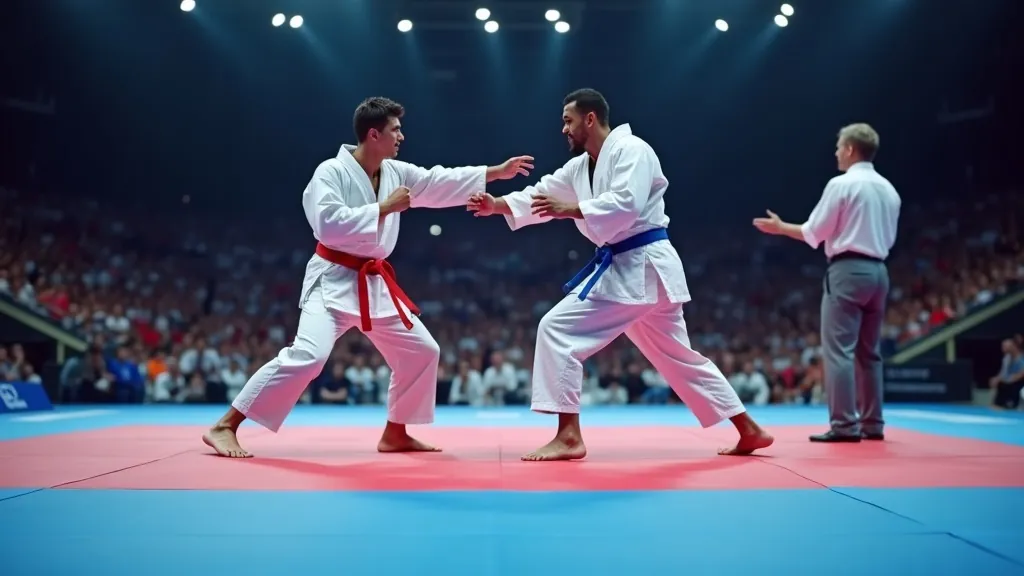
Sanshinkan All India Open
Five hundred athletes at Talkatora Indoor Stadium, New Delhi, in a single day, completely paperless: check-in, ID cards, kumite and kata scoring on every tatami, public displays and same-day medals.
SJJIF India Trials
National jiu jitsu trials run end to end on the platform: online registration, brackets, live scoring, results, and the gold medal list that fed selection for Tokyo.
One network
The athlete, the parent, the coach, the academy, the organiser. They were never five separate customers. They are one network passing the same information between them, badly. KombatOS is the attempt to pass it properly.
The piece that took longest is the one families see: the member and parent portal. It shipped last on purpose. Everything else had to be true first, because a portal that shows a family an empty or half-right record is worse than no portal at all.
Run your academy and your tournaments on one system
From the first enquiry to a black belt to a podium finish. Free to start.